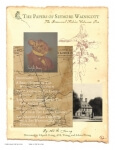
Blog provenance

Seymore Wainscott, born in 1737 in the Piedmont region of Virginia, is the central character in this fictional story of creative genius, home, family, and endurance.

The Papers of Seymore Waisncott is not just a story told as a narrative. Instead, it is an editorial project after the fashion of such monumental projects as the Papers of George Washington, The Papers of James Madison, and the collected writings of other luminaries of the 18th century. After all, Seymore Wainscott was the most gifted mouse of his time.

February 22, 2012

Places: Tuckahoe

By Al R. Young

Situated about 60 miles from Lanham Plantation, Tuckahoe was important in the constellation of lytfolc colonies associated with the colony at Lanham.

Most notably, Tuckahoe was home to Claxton Woodruff, who married Merrinand Wainscott (Seymore Wainscott's daughter) in 1795. The couple made their home at Tuckahoe, and it was between Lanham and Tuckahoe that most of the letters--in what became known as The White Pavilion collection--were exchanged.

According to other documents in The Wainscott Collection, Tuckahoe was among the large community of lytfolc colonies to which various commodities, produced by The Lanham Colony, were shipped.

Leornian Feldham, not only a horticulturalist but a traveler at heart, visited Tuckahoe in 1737 as part of what became a lifetime's avocation of garden tours.  Undoubtedly, he was drawn to Tuckahoe by the fame of its gardens, and later consulted with the colony there about a wide variety of horticultural issues.  Consequently, Tuckahoe was a destination among the itineraries of Seymore and Leorian's balloon voyages.

Among the greatfolc, Tuckahoe is perhaps most widely known as a boyhood home of Thomas Jefferson.

Rendering of Tuckahoe
(unknown artist, unknown date)
from The Wainscott Collection

February 16, 2012

The Boxwood Folios feature new artworks

The first issue of The Papers of Seymore Wainscott features illustrations crafted especially for this volume by the artists of Al Young Studios.

In addition to a small number of carefully selected photographs presenting scenes from the region in which the story is set, the following original artworks and document facsimiles help set the stage for the lytfolc world of Lanham Plantation.

An oil painting of Smythe Lacey is the first in a series of diminutive portraits featuring prominent personalities.

The Governor's Palace, a pencil drawing from 1987, by Al R. Young, features an important architectural icon from Williamsburg, where Seymore spent the happiest days of his youth.

The issue also presents a facsimile of Folio I, from The Boxwood Folios created by Smythe Lacey.  Discovery of this document in the pages of a book printed in 1710, provides important insight into the origins of the lytfolc.

One article in the issue summaries the historical background of the lytfolc colony at Lanham Plantation.  Illustrations accompanying this brief history present preliminary sketches and a portrait in miniature, in which Merrinand Wainscott imitates the limning work of English miniaturist Nicholas Hilliard (circa 1547-1619).

Another featured artwork from The Wainscott Collection, is a full-length, pen and ink drawing of Seymore Wainscott, also by his daughter, Merrinand.

February 15, 2012

Characters: Canny Travers

By Al R. Young

Couriers, introduced in the biography of Bevel Wainscott, played a major role in communication between the widely scattered lytfolc communities of Virginia's Piedmont and Tidewater regions.  Because of the adventure inherent in a courier's daily life, and the personalities drawn to it, couriers are among the more colorful and captivating characters among the lytfolc.

When Bevel and his young family relocated from The Lanham Colony to the colony at Stony Ridge, Canny Travers was the courier who befriended the young Seymore and his sister.  Periodically the silhouette of this dapper and wiry escort appeared at the entrance to the small compartment in the carriage where the two children had been tucked away for the long journey.  Reaching into a concealed pocket in his baldric, Canny would produce a sweet for each.

As with so much of the story, I did not know when I first wrote about the couriers--and about Canny in particular--that he would show up later in the story.  (And since the story is still being written, he may show up again for all I know.)  Most recently, he appeared in "Kite Tails and Balloon Voyages" (part 11 of The White Pavilion series), in which the influence of the couriers on Seymore's youth is once again significant; and, once again, Canny presents Seymore with a gift of special magnificence.

Pen and ink on water color paper
(found among folios attributed
to Seymore Wainscott) thought
to be a sketch of Canny Travers,
circa 1795

February 9, 2012

A Home for Literature

In part 16 of The White Pavilion, Seymore Wainscott answers another question from his daughter; this time focusing on how he and Bryhta created and maintained a peaceful environment at home in the midst of a very active household.  Entitled "A Home for Literature," the installment describes three things near the heart of any peaceful home:  Sanctuary, humor, and literature.

This new installment in the series appears as the Writer's Garret in the next issue of The Storybook Home Journal.  The issue -- now in proofreading and final layout -- features Anthony Trollope's endearing story of Rachel Ray.

The White Pavilion is a collection of letters written by Seymore Wainscott to his daughter, Merrinand.  Shortly after her marriage to Claxton Woodruff in 1795, the couple relocated to Tuckahoe, 60 miles east of the Wainscott home at Lanham Plantation.  Faced with helping Claxton establish their own home together, Merrinand wrote her father to ask about the origins of her childhood home at the orangery on the grounds of Lanham Hall - The legendary White Pavilion.

The Boxwood Folios give background for Seymore's story

The Boxwood Folios issue of The Papers of Seymore Wainscott sets the stage for the telling of a poignant story of creative genius, home, family, and endurance.

These sections in the 24-page issue introduce the series as a whole:

     Provenance
     A Brief History of The Wainscott Collection
     The Planting of The Lanham Colony
     The Centenniarie Map of The Lanham Colony
     Notes on the Society and Guilds of The Lanham Colony

In the Provenance, Al describes how a used book sale at the University of Virginia more than 30 years ago, and a letter, in 1998, from a former associate at UVA, turned into the editorial project of a lifetime.

In A Brief History of The Wainscott Collection (the rare collection of original documents and artifacts from which The Papers derives), Al explains the pivotal part played by Smythe Lacey (1830-1919) in preserving the documents, artifacts, and artworks from the ravages of the Civil War and deterioration of the collection's home.

The Planting of The Lanham Colony presents the text of a document written by Foliaceous Gatherum (1681-1798), and transcribed by Smythe Lacey.  In it, Foliaceous summarizes the history of the old world origins of the lytfolc who immigrated to North America in the 17th century, and then embarked a century later on the planting of the Lanham Colony in the Piedmont region of Virginia.

The Centenniarie Map of The Lanham Colony is featured in an earlier blog post.

Notes on the Society and Guilds of The Lanham Colony was written by Smythe Lacey, and presents the best extant description of 18th century colonial lytfolc societies.  This document comments on the nature of lytfolc families, life expectancy, communities, as well as the guilds (such as the burrowers, mongers, tappits, and others) that were the basis of manufacturing and commerce among these societies.

Full-color illustrations in this issue open windows onto the setting for Seymore's story, and showcase facsimiles of the kind of original documents from which the story emerged.

February 8, 2012

The Boxwood Folios feature Centenniarie Map

The Centenniarie Map of The Lanham Colony is a featured document in The Boxwood Folios issue of The Papers of Seymore Wainscott.

Dated 1822, the map presents the "gates flets thoroughfares villages and watches" belonging to the lytfolc colony at Lanham Plantation, at the time of the colony's centennial.  A gazetteer, attributed to Pyper Wainscott (Seymore's youngest son), accompanies the map and provides brief descriptions of its 94 features.

This particular document in The Wainscott Collection is one of the most labor-intensive creations to date.  Al created the font (used for all of the map's place names) based on labels from a map printed in the early 1700s.

The Roman font in the map's title pane derives from original pen and ink work by Ashton.

Al rendered the map and named each of its features, ensuring that the etymology of each name consists with the culture and heritage of the colony's diverse communities.  This results in names as rich in story as place names in "the real world."

The paper on which the map appears is one of the "antique papers" created at the Studios as part of the Old Dominion Project, from which The Papers of Seymore Wainscott derives.

The many hours devoted to the map's creation occupied much of January 2012.

Detail from The Centenniarie Map of The Lanham Colony

February 2, 2012

Excerpts: Adversity

This excerpt from The Papers of Seymore Wainscott appears among footnotes to the first installment in the series of letters known as The White Pavilion. When asked how a child can overcome problems resulting from the wreckage of a parent's life, Seymore replied:
As you describe your colleague’s struggle with his father, I cannot but think of the wreckage of dead limbs and broken spines to be found at the base of the paternal pillars from which rises the canopy of the forest. That twisted wreckage of lives passed is the very thing that protects a seedling in its tender and delectable years when one nibble from a grazing deer can do more damage than a lightning bolt or an avalanche. . . . as with all adversity, the chief thing is to get past it. Seedlings do not grow toward darkness; they grow toward light. My advice? Find the light. Reach for it. Live for it. Pull yourself up by it. Gratitude always makes for straighter, taller trees.